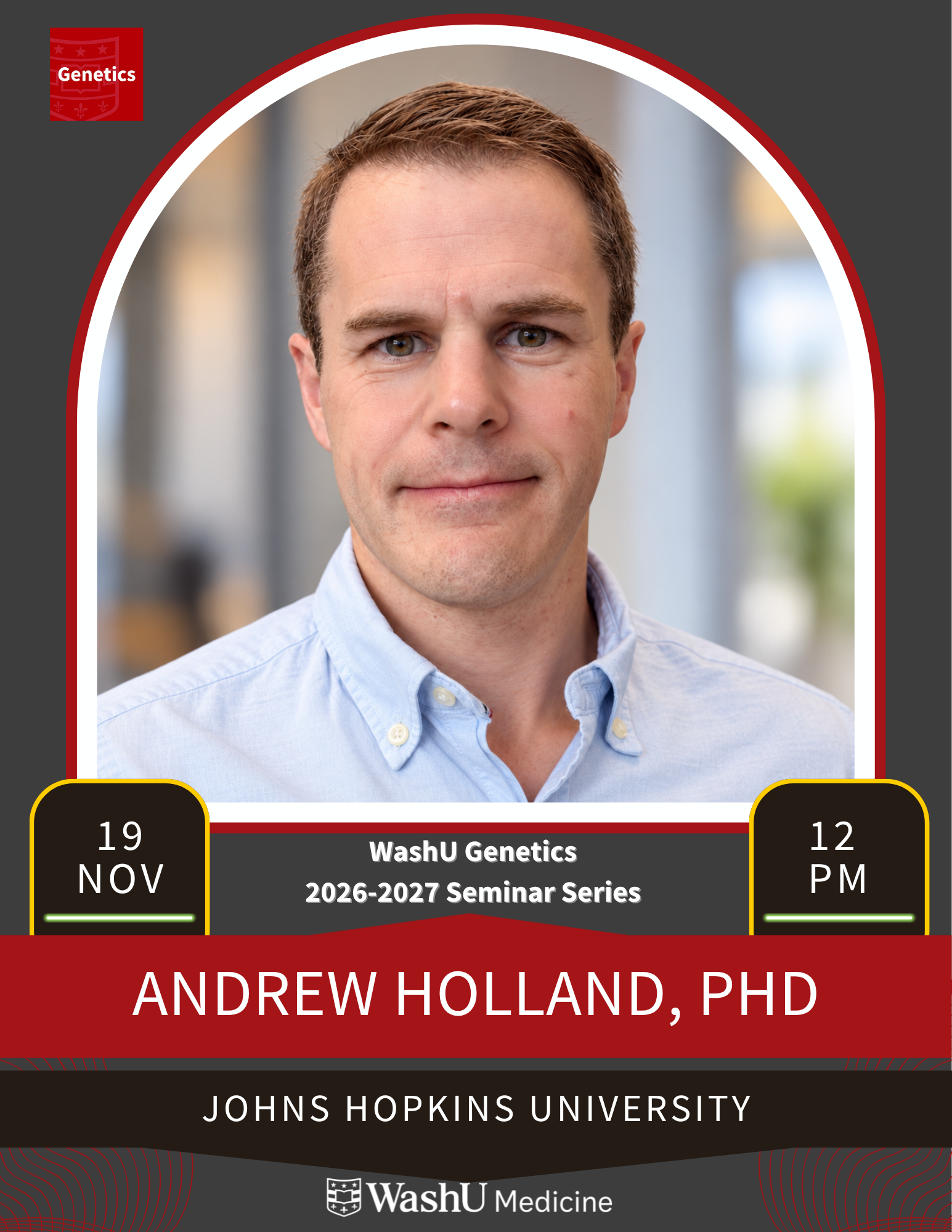
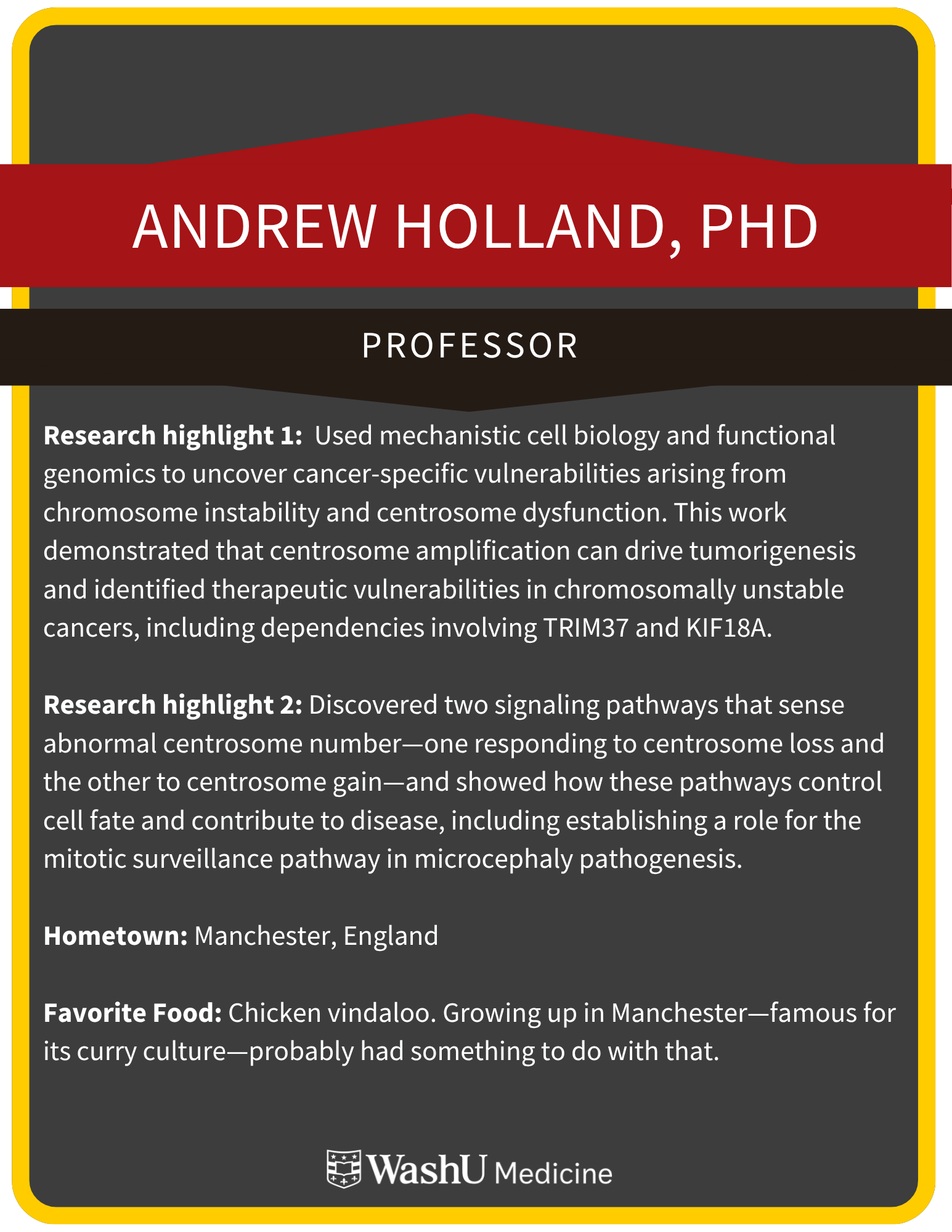
Andrew Holland, PhD
Senior Director, Oncology Research
Amgen
Professor, Johns Hopkins University
Talk Title: Mechanisms, Vulnerabilities and Opportunities in Precision Cancer Therapy
Abstract: My talk will highlight work from my academic laboratory at Johns Hopkins, where we used mechanistic cancer biology and functional genomics to uncover vulnerabilities arising from chromosome instability and tumor-specific dependencies. I will then discuss how I have carried these principles into oncology drug discovery at Amgen, using examples of cancer-specific dependencies to illustrate how mechanistic discoveries can be translated into target-validation and drug-discovery strategies.
Host: Dr. Susan Dutcher
Host Comments: Andrew Holland was an undergraduate at the University of Cambridge (2002) and received his Ph. D. from the University of Manchester in 2006. He was a postdoctoral fellow at the University of California, San Diego where he began research in chromosome instability and centrosome biology. He moved to Baltimore Maryland and Johns Hopkins University in the School of Medicine. Centrosomes play a key role by helping to build a bipolar spindle for chromosome segregation. Centrosomes are tightly coupled to DNA replication and the transition from G1 to S in the cell cycle and play roles in response to DNA damage.
Andrew was at Hopkins from 2007 to 2013 where he became a full professor. He received many awards that include the Pew’s Scholar Award, the Basil O’Connor Scholar Award, the Lee Hood Prize in Biomedical Sciences, and the Johns Hopkins President’s Fellow Award. He was also an American Cancer Society Research Scholar. In 2023, he joined Amgen as the Director of Oncology Research.
Several key papers has shown that centrosome amplification can promote tumorigenesis in mammals, that PIDDosome is recruited to the centrosome after amplification, and screens for synthetic lethality.