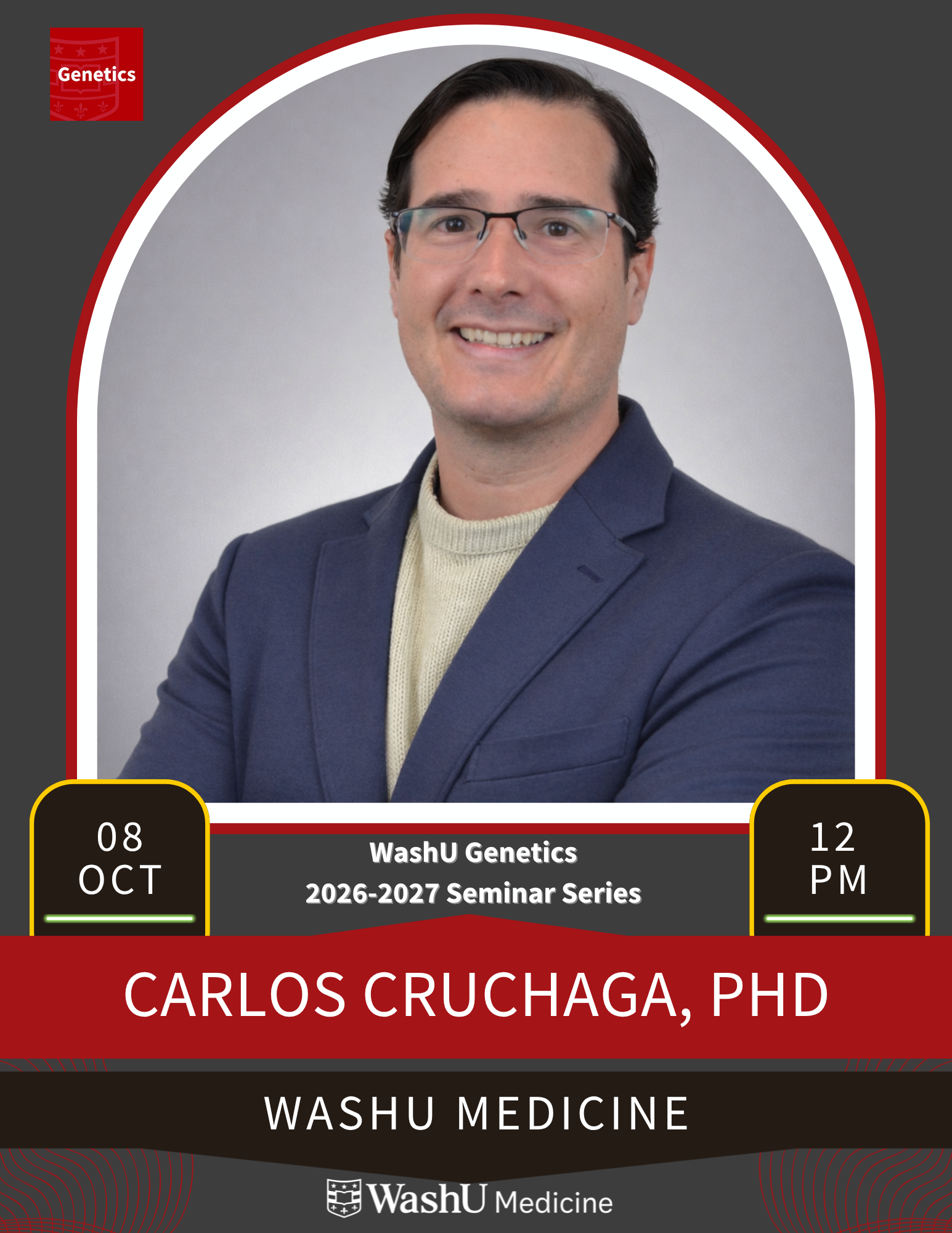
Carlos Cruchaga, PhD
Professor, Dept. of Psychiatry, Neurology and Genetics
WashU Medicine
Talk title: High-Dimensional multi-omics for Neurodegeneration: From Blood Signatures to Mechanistic Insight in Alzheimer’s and Related Dementias
Abstract: Large scale, high dimensional proteomics across plasma, CSF, and multiple tissues is transforming Alzheimer’s and neurodegenerative disease research, from biomarker discovery to mechanistic insight. Plasma and CSF AD proteomics informs about disease pathways, treatment responsive biomarker dynamics with lecanemab. Multi disease AI models can accurately classify AD, PD, FTD, and DLB and detect co pathologies. Proteomics—integrated with genetics, longitudinal cohorts, and AI—reveals hidden biology, improves prediction, and enables precision medicine across neurodegenerative diseases.
Host: Dr. Nancy Saccone
Host comments: Dr. Carlos Cruchaga is an international leader in the study of Alzheimer’s Disease and other dementias and neurodegenerative disorders. His group employs human multi-omics – genetics, genomics, transcriptomics, proteomics, metabolomics, and more – to understand and predict risk, progression, prognosis, and drug response for these complex diseases. In addition to his national and international leadership and collaborations, he has deep connections throughout Washington University. After training at the University of Navarra and the Center for Applied Medical Research in Spain, he came to WashU for postdoctoral work with Dr. Alison Goate and then started his independent lab here in 2011. He now holds the Barbara Burton and Reuben Morriss III Endowed Professorship at WashU, in recognition of his foundational work and the sustained and future impact of his research program. His work identified novel genes and variants in AD and AD pathology and has led to increased recognition of the utility of blood and plasma-based biomarkers. As the founding director of the Neurogenomics and Informatics Center at Washington University, he oversees diverse efforts to understand neurodegenerative diseases on a deep genetic and molecular level to ultimately improve patient care.