What if a simple metabolic byproduct could sharpen memory? Researchers at Washington University School of Medicine have discovered that acetate, a ubiquitous metabolite, can significantly enhance long-term memory in female mice by reshaping the epigenetic and transcriptional landscape of key learning centers. The findings, published in Science Signaling, reveal that memory enhancement can arise from subtle metabolic byproducts that interact with chromatin in sex- and context-specific ways.

Led by Gabor Egervari, PhD, Assistant Professor in the Departments of Genetics and Biochemistry and Molecular Biophysics, the study shows that acetate boosts memory performance in non–alcohol-related learning and memory tasks, uncovering a previously unrecognized role for this small molecule in cognitive function. While acetate is best known as a metabolic intermediate and byproduct of alcohol metabolism, this new work demonstrates that this metabolite can act independently to promote learning and memory by regulating histone modifications and gene expression in the brain.
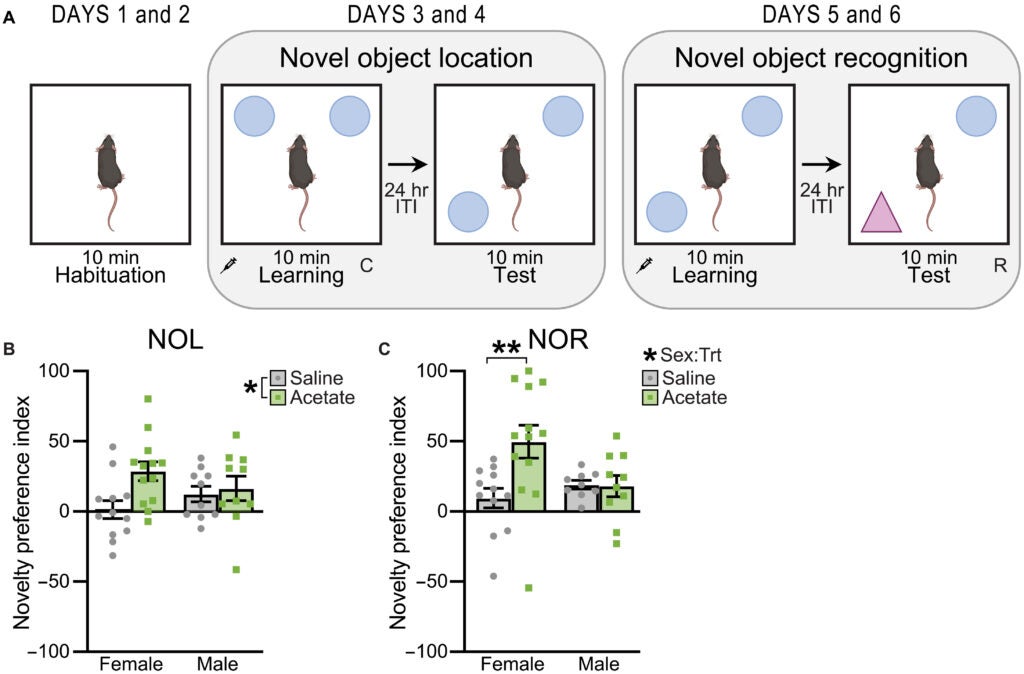
Using a combination of behavioral assays, including novel object location and novel object recognition tasks, the researchers found that acetate exposure improved long-term memory, with the most pronounced effects observed in female mice. These behavioral results were tightly linked to molecular changes in the dorsal hippocampus, a brain region critical for learning and memory.
“For us, the most exciting part was seeing how the behavioral effects lined up with what was happening at the molecular level,” said Erica Periandri, Research Specialist in the Egervari lab and first author of the study. “Acetate wasn’t just changing gene expression in a general way – it was specifically engaging learning-related epigenetic and gene expression programs in the dorsal hippocampus, and doing so differently in females and males.”
At the molecular level, acetate triggered robust epigenetic remodeling in the female dorsal hippocampus following memory recall. In particular, the metabolite increased acetylation of the histone variant H2A.Z, a chromatin modification associated with transcriptional activation and neuronal plasticity. This epigenetic shift opened the door to coordinated activation of genes involved in learning and memory. Strikingly, these changes were generally absent in males and did not occur when acetate was administered outside of a learning context, highlighting the importance of both sex and experience.
Gene expression analyses reinforced this specificity. Acetate selectively amplified learning-related transcriptional programs in the female dorsal hippocampus, including genes previously linked to memory formation and synaptic remodeling. Many of these genes depend on H2A.Z, directly connecting acetate-driven chromatin changes to functional outcomes in memory. In contrast, acetate had far weaker effects on memory-related gene expression in males and in other brain regions.
“Our study shows that metabolism and memory are more intimately connected than previously appreciated,” said Gabor Egervari, MD, PhD. “A single metabolite can reshape chromatin and gene expression in ways that enhance memory, but only under the right conditions and in a sex-specific manner.”
The researchers also found that acetate’s effects unfold differently across memory phases, with distinct molecular signatures during early consolidation versus after recall. Importantly, acetate exposure in mice that were not engaged in learning failed to reproduce these memory-linked epigenetic and transcriptional changes, highlighting the context-dependent nature of metabolic regulation in the brain.
Together, these findings position acetate as a powerful modulator of learning-related gene regulation and highlight metabolism as a key, yet underexplored, driver of cognitive function. By illuminating sex-specific pathways that enhance memory, the study opens new avenues for therapeutic strategies aimed at cognitive aging, Alzheimer’s disease, and other conditions marked by memory decline that disproportionately affect the female population.