The new research will focus on understanding how disease-associated microglia change over time and how these changes may contribute to Alzheimer’s disease progression, potentially revealing new opportunities for therapeutic designs.

Microglia are the brain’s resident immune cells and play an important role in responding to injury and disease. In Alzheimer’s disease, a specific state of microglia known as disease-associated microglia (DAM) becomes activated around amyloid plaques and tau tangles. While these cells may initially help protect the brain, growing evidence suggests that they become dysfunctional and may lead to damages as the disease progresses.
Li, an assistant professor of genetics and neuroscience at Washington University School of Medicine in St. Louis, and his team aim to understand how and why these changes occur.
“We are trying to understand the dynamic changes of disease-associated microglia in Alzheimer’s disease,” Li said.
Following microglia over time
Much of what scientists know about microglia comes from studies that examine cells at individual stages of disease. Researchers can isolate microglia at different points, profile their molecular characteristics and compare the results, just like taking a series of snapshots.
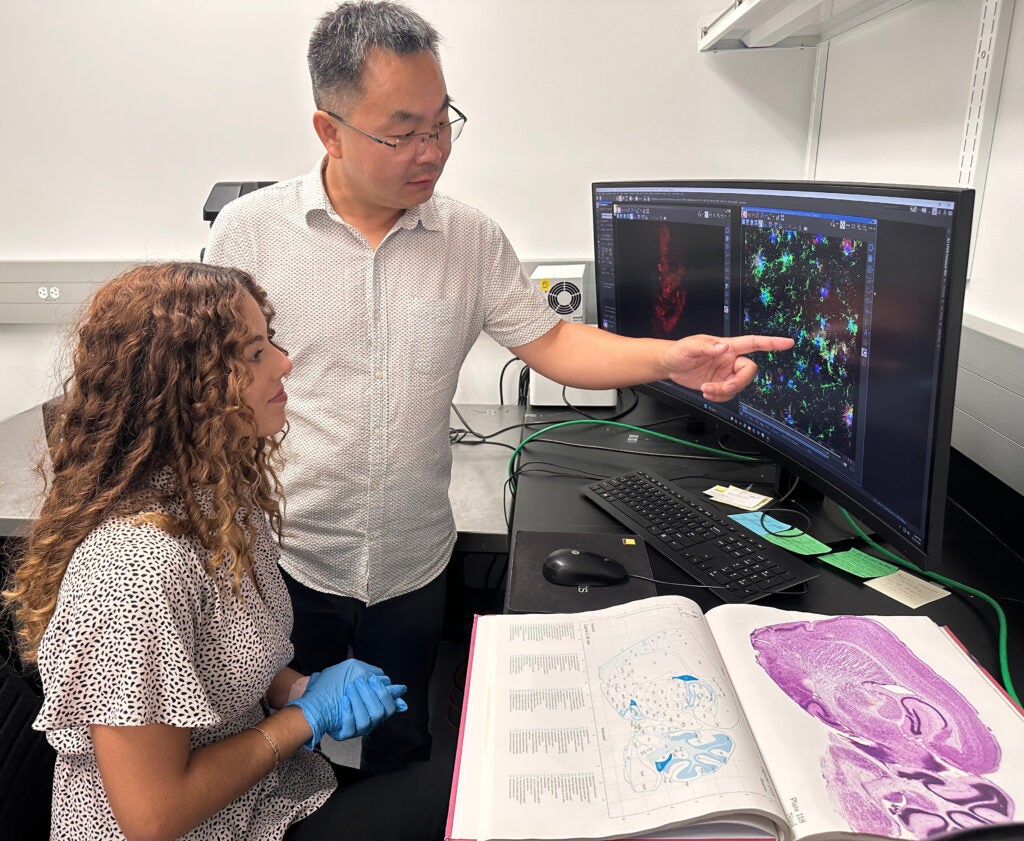
Li’s research will take a different approach. Using genetic tools developed by his laboratory, the researchers can track the same population of microglia over time, so they can piece together the “snapshots”, and sometimes quite literally taking movies on microglia, to observe how the cells change as Alzheimer’s disease progresses.
This longitudinal approach builds on the Li lab’s previous work demonstrating that reactive microglia are highly plastic and can change their state in response to their microenvironment in the brain.
In earlier studies, the lab focused on microglial responses to acute injury, including how the cells can return toward a more normal state during recovery. The new R01 project will examine whether microglia have similar flexibility during the chronic and progressive neurodegeneration associated with Alzheimer’s disease.
From understanding to intervention
The project is inspired in part by human genetic studies linking microglia and Alzheimer’s disease risk. Several genes associated with Alzheimer’s disease risk are active in microglia, providing evidence that these cells play an important role in the disease.
By identifying the molecular and epigenetic mechanisms that drive microglial changes, Li hopes the research will provide new insights into how these cells influence Alzheimer’s pathology and potentially identify strategies for manipulating their behavior.
“We’re still scratching the surface where we’re trying to find what’s in the box,” Li said. “The more important next step is to figure out how the change is regulated and whether we can harness this mechanistic understanding to promote therapeutic designs.”

A continued line of Alzheimer’s research
The R01 is Li’s second major R01 award and provides an opportunity for his laboratory to continue developing its research program focused on microglia and Alzheimer’s disease.
“It’s amazing that we can have a continuous line of work on this topic related to Alzheimer’s disease,” Li said. “We truly are privileged by the trust that the funding agencies and colleagues have in our research.”
Li also emphasized that the award reflects the contributions of many people who have supported the work, including his former mentors, collaborators, colleagues, and, especially, the students in his laboratory.
“Without them, this would have been impossible,” he said.
Through the new project, Li and his team hope to move beyond characterizing how microglia change in Alzheimer’s disease toward understanding the mechanisms that control those changes, a step that could ultimately inform new approaches for therapeutics targeting microglia in neurodegenerative disease.