HALO Center researchers win $1.53M NIH grant to accelerate AI longevity research (Links to an external site)

Despite decades of study, the genetic, molecular and environmental influences that drive extended health span and delayed onset of age-related disease are not fully understood. A multidisciplinary team of researchers plans to address this gap by creating interpretable graph neural network models capable of integrating large, multi-omic datasets collected from centenarians and other long-lived individuals with a three-year, $1.53 million grant from the National Institutes of Health (NIH) to develop transparent artificial intelligence (AI) models that may reveal the biological underpinnings of exceptional human longevity.

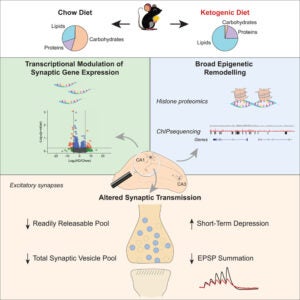
Researchers decode how a ketogenic diet modifies brain synaptic function

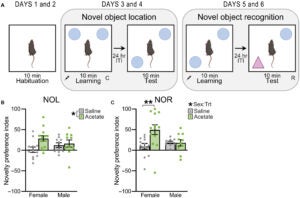
featured figure of the research

A collaborative research effort between laboratories at Washington University School of Medicine has identified molecular and cellular mechanisms by which a ketogenic diet (KD) alters synaptic communication in the brain — revealing how metabolic state can reshape neuronal networks at the transcriptional, epigenetic, and physiological levels. Spearheaded by first authors Marion Stunault, PhD, Pan-Yue Deng, PhD and Anjali Yadav, PhD, the study, “Ketogenic diet dampens excitatory neurotransmission by shrinking synaptic vesicle pools,” was recently published in Cell Reports and provides foundational insight into how diet-induced metabolic changes influence excitatory circuits in the hippocampus.

Frederick Arnold, PhD, Awarded ALS Network Research Innovation Grant

Frederick Arnold, PhD, Assistant Professor in the Department of Genetics at Washington University School of Medicine, has been awarded a 2025 Research Innovation Grant from the ALS Network and ALS United. The award provides $150,000 in funding over one year to support his research in amyotrophic lateral sclerosis (ALS).

Zefan (Vivien) Li Named WashU Pivot 314 Fellow

Zefan (Vivien) Li, a third-year graduate student in the Jin lab, has been selected for the 2026 cohort of Washington University in St. Louis’s Pivot 314 Fellowship, a competitive program that supports emerging leaders across disciplines.

Assistant Professor Aki Ushiki Awarded Preeclampsia Foundation’s Peter J. Pappas Research Grant

Aki Ushiki, PhD, assistant professor in the Department of Genetics at Washington University School of Medicine in St. Louis, has been awarded a 2026 Peter J. Pappas Research Grant from the Preeclampsia Foundation. The award provides $99,997 in research funding to support innovative studies aimed at improving outcomes for pregnant individuals and babies affected by preeclampsia and related hypertensive disorders of pregnancy.

Researchers Illuminate the Epigenetic Basis of Microglial Plasticity

A collaborative research effort between the laboratories of Qingyun Li, PhD, assistant professor in the Departments of Genetics and Neuroscience, and Harrison Gabel, PhD, associate professor in the Department of Neuroscience at Washington University School of Medicine has uncovered fundamental mechanisms that govern how microglia—the brain’s resident immune cells—adapt their functional states across development, aging, and disease. The study, “State-specific enhancer landscapes govern microglial plasticity,” was recently published in Immunity.

Yang Li, PhD, awarded prestigious ALSF ‘A’ Award Grant for pediatric brain tumor research

The Department of Genetics is proud to announce that Yang Li, PhD, Assistant Professor of Genetics and Neurosurgery, has been selected as a recipient of the 2025 Alex’s Lemonade Stand Foundation (ALSF) ‘A’ Award Grant for his groundbreaking work in childhood cancer research. The award provides $800,000 in total funding over four years, supporting Dr. Li’s efforts to advance understanding of aggressive pediatric brain tumors.

Jeffrey Milbrandt, MD, PhD receives the Dean’s Medal for Innovation and Commercialization (Links to an external site)

Jeff Milbrandt, MD, PhD, the James S. McDonnell Professor of Genetics and executive director of the McDonnell Genome Institute, and Aaron DiAntonio, MD, PhD, the Alan A. and Edith L. Wolff Professor of Developmental Biology, received the Dean’s Medal for Innovation and Commercialization for their high-caliber scientific research and commercialization achievements.

Graduate student Kia Barclay receives Provost’s Research Excellence Award

Graduate student Kia Barclay of the Li Lab has been selected as a Graduate Student Recipient of the 2025 Provost’s Research Excellence Award, a prestigious university-wide honor recognizing outstanding research achievement. Barclay is one of only seven students across both the Danforth and Medical campuses to receive the award this year—and the sole honoree representing the School of Medicine, underscoring the exceptional impact of her scientific contributions.