Follow us
Stay informed about what’s happening in the Genetics Department by following us on LinkedIn: @WashUGenetics, Twitter: @WashUGenetics and Bluesky: @washugenetics.bsky.social
News
Congratulations to the 2026 Dean’s Impact Award Recipient, Dr. Michael Province (Links to an external site)

The 2026 Dean’s Impact Award focuses on “Honoring the Focused Excellence of Exemplary Clinicians and Researchers.”
Recipients of the Dean’s Impact Awards represent the compassion, innovation, and commitment required to build dynamic, meaningful, and community-focused efforts to improve clinical care, education, and research. Congratulations to Dr. Michael Province on receiving this honor!
WashU Medicine Genetics Ranks No. 5 in NIH Funding for 2025
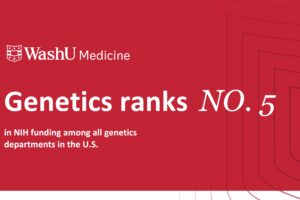
The Department of Genetics at Washington University School of Medicine in St. Louis has been ranked No. 5 in the nation for NIH funding in 2025, according to the latest report from the Blue Ridge Institute for Medical Research. The achievement places WashU Medicine’s genetics department among the nation’s most well-funded hubs of genetic discovery, ahead of many prestigious research institutions.
Guoyan Zhao, PhD, delivers Dutcher Tenure Recognition Seminar
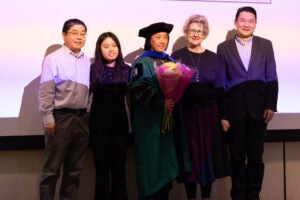
The Department of Genetics Seminar Series continued on Thursday, February 26, with the Dutcher Tenure Recognition Seminar, featuring an in-person presentation by Guoyan Zhao, PhD, Associate Professor with Tenure in the Department of Genetics at WashU Medicine. Held in Moore Auditorium, the event brought together faculty, trainees, and staff to celebrate Dr. Zhao’s promotion and scientific accomplishments.
The Dutcher Tenure Recognition Seminar is a long-held tradition in the Department of Genetics, honoring faculty members upon their promotion to tenure. The seminar recognizes not only their research excellence, but also their contributions to mentorship, scholarship, and the academic community.
Sex-specific epigenetic remodeling links acetate to memory enhancement
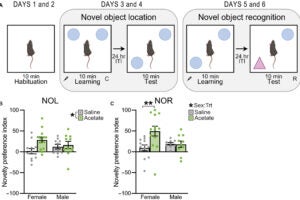
What if a simple metabolic byproduct could sharpen memory? Researchers at Washington University School of Medicine have discovered that acetate, a ubiquitous metabolite, can significantly enhance long-term memory in female mice by reshaping the epigenetic and transcriptional landscape of key learning centers. The findings, published in Science Signaling, reveal that memory enhancement can arise from subtle metabolic byproducts that interact with chromatin in sex- and context-specific ways.
HALO Center researchers win $1.53M NIH grant to accelerate AI longevity research (Links to an external site)
Despite decades of study, the genetic, molecular and environmental influences that drive extended health span and delayed onset of age-related disease are not fully understood. A multidisciplinary team of researchers plans to address this gap by creating interpretable graph neural network models capable of integrating large, multi-omic datasets collected from centenarians and other long-lived individuals with a three-year, $1.53 million grant from the National Institutes of Health (NIH) to develop transparent artificial intelligence (AI) models that may reveal the biological underpinnings of exceptional human longevity.
Upcoming Events
-
8
Apr -
9
Apr -
15
Apr -
16
Apr -
22
Apr