The Schedl Lab led by Dr. Tim Schedl recently received NIGMS R35 grant. The grant provides funding for studying “control of germline stem cells and the switch to meiotic development in C. elegans” for 5 years.
The Schedl Lab Receives R35 Grant
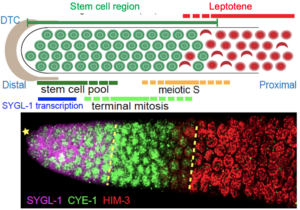
The Schedl Lab led by Dr. Tim Schedl recently received NIGMS R35 grant. The grant provides funding for studying “control of germline stem cells and the switch to meiotic development in C. elegans” for 5 years.
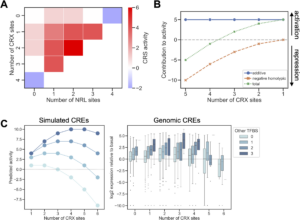
In the new study published in Genome Research, postdoctoral fellow Ju Heon Maeng has developed a suite of computational tools to significantly improve immunopeptidome detection from transposable element expression, utilizing long-read data.
After 24 years of professorship at Washington University School of Medicine in St. Louis, Dr. Gary Stormo, the Joseph Erlanger Professor of Genetics, retires at the age of 73.
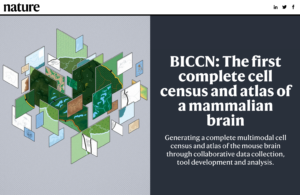
As part of NIH’s BRAIN Initiative, Nature recently published 10 papers mapping the first mammalian brain. Genetics Assistant Professor Dr. Yang (Eric) Li, a contributor in this project, co-first-authored one of the Nature papers titled: Single-cell analysis of chromatin accessibility in the adult mouse brain. Li has also contributed to two other papers in this […]
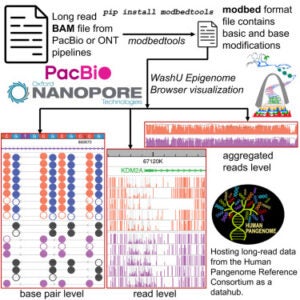
The WashU Epigenome Browser has introduced the Modbed track data type that allows for the visualization of modification details at the level of individual long reads, as well as the display of merged modification information for one or more long reads within a dynamic resolution range.
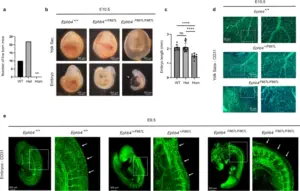
A new study led by WashU graduate student Shujuan Zhao, co-mentored by Dr. Sheng Chih (Peter) Jin, Assistant Professor of Genetics and Pediatrics, Washington University School of Medicine, and Dr. Kristopher T. Kahle, Director of Pediatric Neurosurgery, Massachusetts General Hospital, sheds light on new genetic mutations related to the disease and validations of the identified genes in mouse and zebrafish models. This collaborative work was recently published in Nature Communications.
In Yang Eric Li’s newly published paper in Science, A comparative atlas of single-cell chromatin accessibility in the human brain, he and his colleagues revealed the largest maps of the human brain, uncovering new information that was never available before.
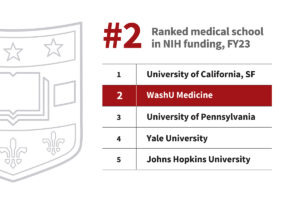
Guoyan Zhao, PhD, recently received her first R01 grant from the National Institutes of Health (NIH), a milestone achievement. WashU Medicine has risen to No. 3 among U.S. medical schools in total NIH research funding support.
The Genetics Department at Washington University coordinates the effort of hosting meetings of National Human Genome Research Institute (NHGRI)-funded consortia. The consortia meetings span 5 days from 9.11 – 9.16 and took place on Washington University School of Medicine campus.
The National Institutes of Health (NIH) is channeling $50.3 million over the next five years into a new consortium dedicated to advancing the generation and analysis of multi-omics data for human health research.